
No, There Aren't 500,000 Comments on OMB's Proposed Reg
Regulations.gov systematically misreports comment counts
Chris also posted this on his blog.
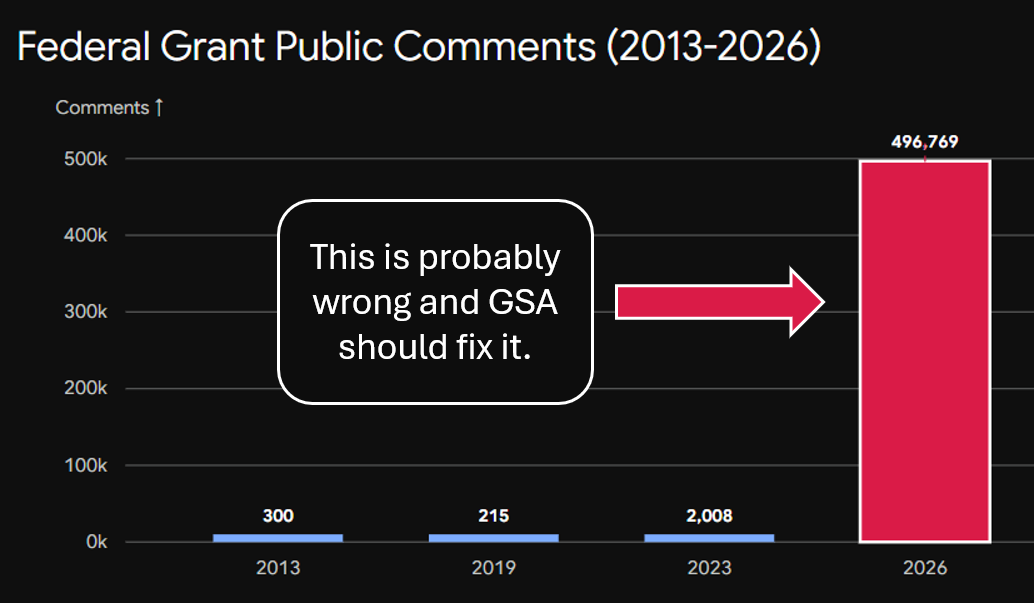
We analyzed over 50,000 comments posted on the Office of Management and Budget’s Proposed Regulation for Federal Financial Assistance (i.e., the Uniform Guidance codified at 2 CFR 200). Many news outlets, including the New York Times, have reported that there were 500,000 comments received and, thus, the posted comments represent only 10% of the true count.
But that’s almost certainly not true. The true count is likely closer to what was already posted by OMB.
Why? Because there is a major flaw in the way that regulations.gov counts comments received. It can be easily gamed to increase the count—and based on the patterns in the data in terms of when OMB has been receiving vs. posting comments, there’s just no 450,000 backlog of comments they have yet to post.
Here’s how to game the system to increase the count:
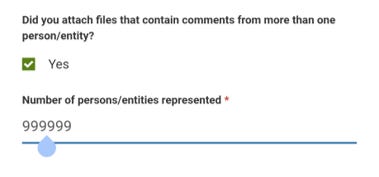
When you add an attachment instead of only using the provided comment field, you’re asked: Did you attach files that contain comments from more than one person/entity?
If you check “Yes”, you’re asked to provide a value in a numeric field for the Number of persons/entities represented.
This is where the game can happen. Whatever value you enter in that field is added to the total number of comments received.
According to the documentation, it takes until 11:59 PM ET of that day for this change to be reflected on the website, which adds to the lack of transparency about what’s happening.
To illustrate this, we conducted a few experiments on notices that are currently open for comment. Here we share the most dramatic, where we incremented the count by 999,999 comments, which is the biggest number you can enter in that field:
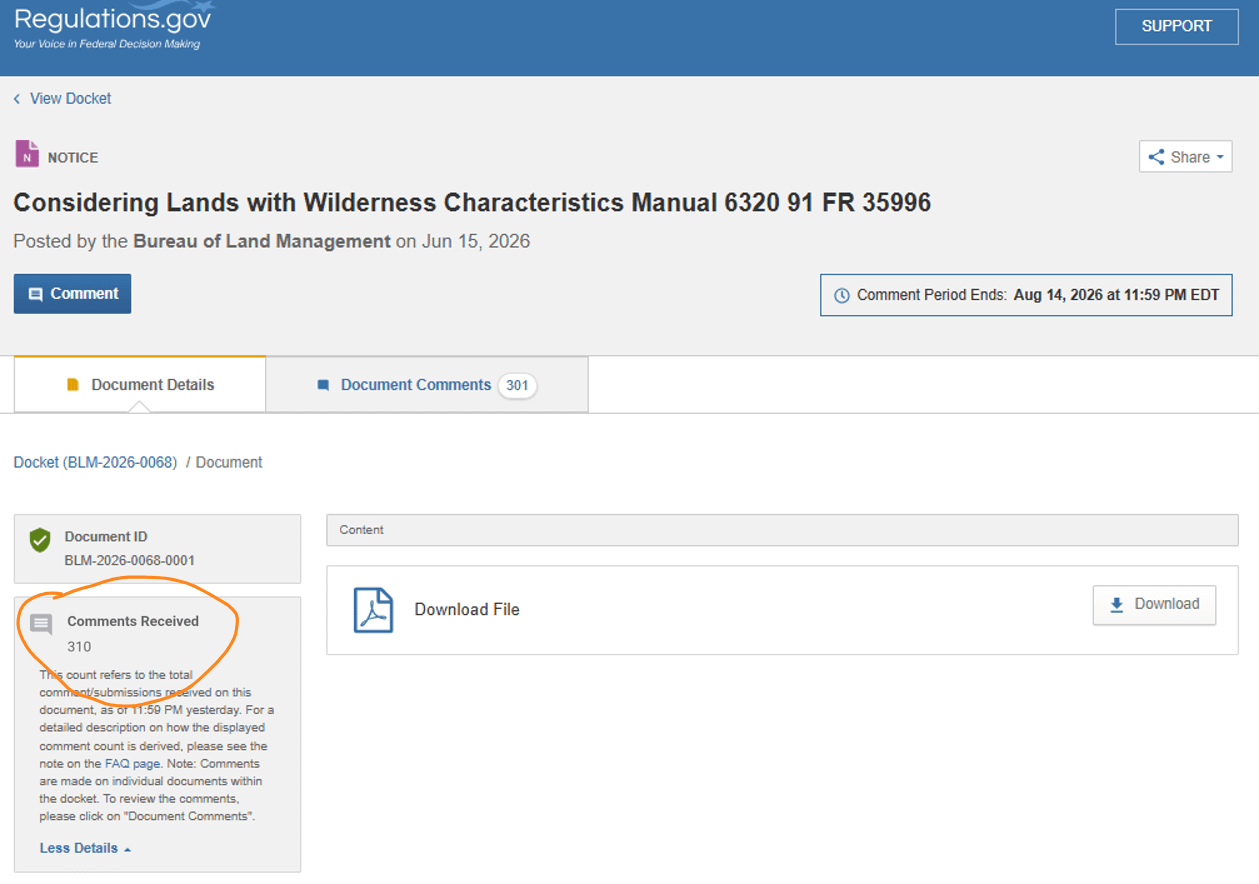
We picked “Considering Lands with Wilderness Characteristics in the BLM Land Use Planning Process”. As of around 8:00 AM ET on 7/16/2026, the total number of comments received was just 310.
We submitted a comment with an attachment and indicated that it represented 999,999 entities:
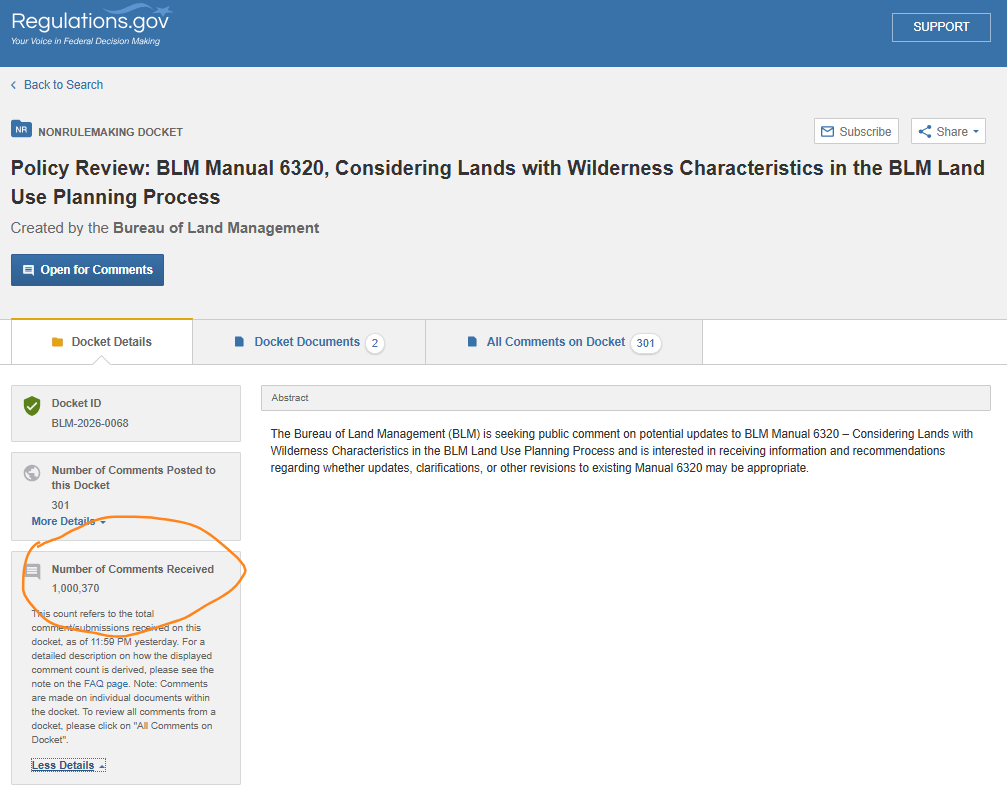
The next day, the total count went up by roughly that amount, now showing a total of over 1 million comments received, with 301 posted.
What does this mean for the 500,000 reported comments on 2 CFR 200? They’re likely not real. But it was reasonable for media outlets to assume they were real. The only way to figure out how this number is calculated via the website is to click on "more details," then "FAQ page," then "How are Comments counted and posted to Regulations.gov?". There, you’ll find an explanation, more or less. But almost no one does that. Neither of us learned it that way; we only know this because it was explained to us.
This method is misleading and GSA should fix it. It should be replaced with a count that actually represents what everyone currently assumes it does—the total number of comments that have been submitted. That way, it will be possible for those following public interest in regulations to track submitted comments, even if there’s a lag in agency posting.
When this many people are getting the meaning of a published statistic wrong, the problem is with the statistic, not the people.
 | A guest post by
|
Cool experiment. I have a different take on how to fix this:
First, I audited every case of attachments claiming to represent more than 99 "comments" from 2005 to 2020, and the only ones with inflated numbers were not from legit organizations. This is because organizations with reputations to maintain don't want to be caught lying to the agencies they are trying to persuade. (https://judgelord.github.io/research/whymail/)
Second, if organizations are trying to drive up the comment count, and the only way to do so is to have a million people submit separate comments, they will tell their supporters to do that. This will (1) make it more difficult to participate, (2) make more of a mess for officials to process, and (3) lead to many more comments (both mass and non-mass) being discarded and lost in the mess.
Thus, the better way would be only to allow official organizations to upload bulk comments from their members and supporters (e.g., by asking for a tax ID number). Indeed, this should be encouraged, because when organizations don't do this and send their members to regulations.gov, they make a real mess of the docket, with lots of comments that add nothing beyond a number to the tally.